Henry Joseph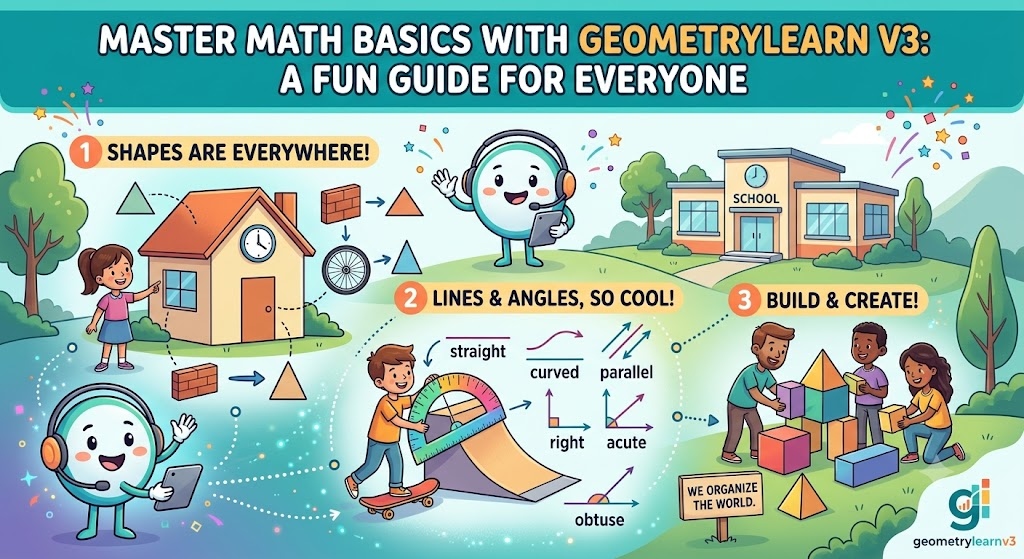
Are you ready to explore the exciting world of shapes, lines, and angles? Welcome to your ultimate guide using geometrylearnv3! Geometry might sound like a big, scary word, but it is actually just the study of the world around us. From the square tiles on your floor to the round wheels on a bike, geometry is everywhere. Using the geometrylearnv3 approach makes learning these concepts feel like playing a game. We will break everything down into simple, bite-sized pieces that are easy to understand. Let’s start this fun journey together and see how math helps us build and organize our amazing world.
What Exactly is geometrylearnv3?
You might wonder, “What makes geometrylearnv3 so special?” It is a friendly way to learn math that focuses on visual patterns and real-life examples. Instead of just memorizing boring formulas, geometrylearnv3 helps you see how shapes work in real time. Think of it like a map that guides you through the basics of space and measurement. Whether you are looking at a simple triangle or a complex cube, this method makes the “why” and “how” very clear. It turns abstract math into something you can touch, see, and feel, which is the best way to truly master the subject.
Starting Your Journey with Basic Shapes
Every great builder starts by learning about the basic shapes. In our geometrylearnv3 system, we start with points, lines, and planes. A point is just a tiny dot marking a spot. When you connect two points, you get a line segment. These are the building blocks for everything else we study. Once you understand these simple pieces, you can start building shapes like squares, circles, and triangles. It is just like playing with building blocks! By using geometrylearnv3 techniques, you will quickly learn to spot these shapes in nature and in your own home.
Understanding Angles in Our World
Angles are everywhere, from the corner of your bedroom wall to the hands on a clock. When two lines meet at a point, they form an angle. Using geometrylearnv3, we classify these as acute (small), right (like a perfect corner), or obtuse (wide). Think of an alligator’s mouth—when it is wide open, that is an obtuse angle! When it is almost closed, it is an acute angle. Learning angles with geometrylearnv3 is fun because you can go on an “angle hunt” around your house. You will be surprised at how many right angles you can find just by looking around!
Measuring Perimeter: The Distance Around
Have you ever wondered how much fence you need for a yard? That is where perimeter comes in. The perimeter is simply the distance around the outside of a shape. With geometrylearnv3, we teach you to add up all the sides to find the total length. Imagine walking along the edge of a park. The path you take around the edge is the perimeter. It is a very useful skill for projects like framing a picture or building a garden. geometrylearnv3 makes this math easy by showing you exactly how to track your steps around any flat shape.
Finding Area: Measuring the Space Inside
While perimeter is the distance around, area tells us how much space is inside a shape. Think of it as the amount of carpet you need to cover a floor. In our geometrylearnv3 lessons, we use little squares to fill up the space. If you have a rectangle, you just multiply the length by the width to get the area. It is a fast and simple trick! geometrylearnv3 helps you see that area is just counting how many squares fit inside. Once you master this, you can measure almost any flat surface you see, which is a great superpower to have.
Exploring 3D Shapes: Volume and Beyond
Now that we know 2D shapes, let’s go 3D! 3D shapes have height, width, and depth, like a ball or a box. We call the space inside these objects “volume.” Using geometrylearnv3, we can figure out how much water a glass can hold or how many blocks fit in a toy chest. It is basically the same as area, but we add one more step. Learning about spheres, cubes, and cones with geometrylearnv3 helps us understand how things take up space in the real world. It is the secret math that architects and engineers use every single day.
How to Practice Geometry Every Day
The best way to get good at anything is to practice, and geometrylearnv3 makes that simple. You don’t need a fancy lab to learn. You can practice while walking outside, playing with toys, or even cooking in the kitchen! Try drawing shapes on paper or using building blocks to create new designs. The more you play with these ideas, the more they will stick in your brain. geometrylearnv3 suggests taking a few minutes each day to look for shapes or measure something new. This consistent practice turns hard work into a fun daily habit.
Why Geometry Matters in Real Life
You might ask, “When will I ever use this?” The answer is: all the time! Geometry is the hidden language of the world. Architects use it to design safe buildings. Artists use it to create beautiful pictures. Even video game designers use geometrylearnv3 concepts to make characters move on your screen. When you understand geometry, you understand how things are put together. It helps you see the world with a smarter eye. From fixing a broken table to planning a room layout, your new skills will be useful for your whole life.
Tips for Success with geometrylearnv3
Learning should be fun, not stressful. If you get stuck, remember that everyone finds math hard sometimes. With geometrylearnv3, the trick is to take a break and come back later. Drawing a picture of the problem often helps clear things up. Don’t be afraid to ask questions or talk to a friend about what you learned. geometrylearnv3 is all about progress, not perfection. Keep a notebook of the shapes and formulas you learn. This will give you a great reference tool to look back on whenever you need a quick reminder.
Conclusion
We have covered a lot, from simple points to complex 3D volume! Remember, geometrylearnv3 is your best tool for keeping things simple and clear. You have learned about shapes, how to measure them, and why they matter in the real world. By using these steps, you are well on your way to becoming a geometry pro. Keep exploring, keep measuring, and most importantly, keep having fun with math! You have all the skills you need to succeed, and geometrylearnv3 is always here to guide you to the next step of your exciting math adventure.
Detailed Learning Guide Table
| Concept | What it is | Why it matters |
| Points/Lines | Basic building blocks | Helps define all shapes |
| Angles | The corner where lines meet | Crucial for building and design |
| Perimeter | Distance around a shape | Used for fencing and borders |
| Area | Space inside a 2D shape | Used for flooring and paint |
| Volume | Space inside a 3D object | Used for filling containers |
Frequently Asked Questions
1. What is the easiest way to start using geometrylearnv3?
Start by looking for shapes in your house. Identify circles, squares, and triangles to get comfortable with the basics.
2. Can kids really use geometrylearnv3 to learn math?
Yes! The language is simple, and it uses real examples that make sense to younger students.
3. Do I need special tools for geometrylearnv3?
Not really! A ruler, a pencil, and some paper are all you need to start your practice.
4. Why is geometry important for school?
It builds logic and spatial skills that help you succeed in all your other subjects, not just math.
5. How often should I practice with geometrylearnv3?
Even 10 to 15 minutes a day will help you get much better at understanding shapes and measurements.
6. Where can I find more help if I am stuck?
Try drawing the shape out on paper or looking for real-world objects that match what you are studying.